The Lighting Guide
A closer look at the hardware behind a well-designed lighting plan — and why each piece earns its place.
01
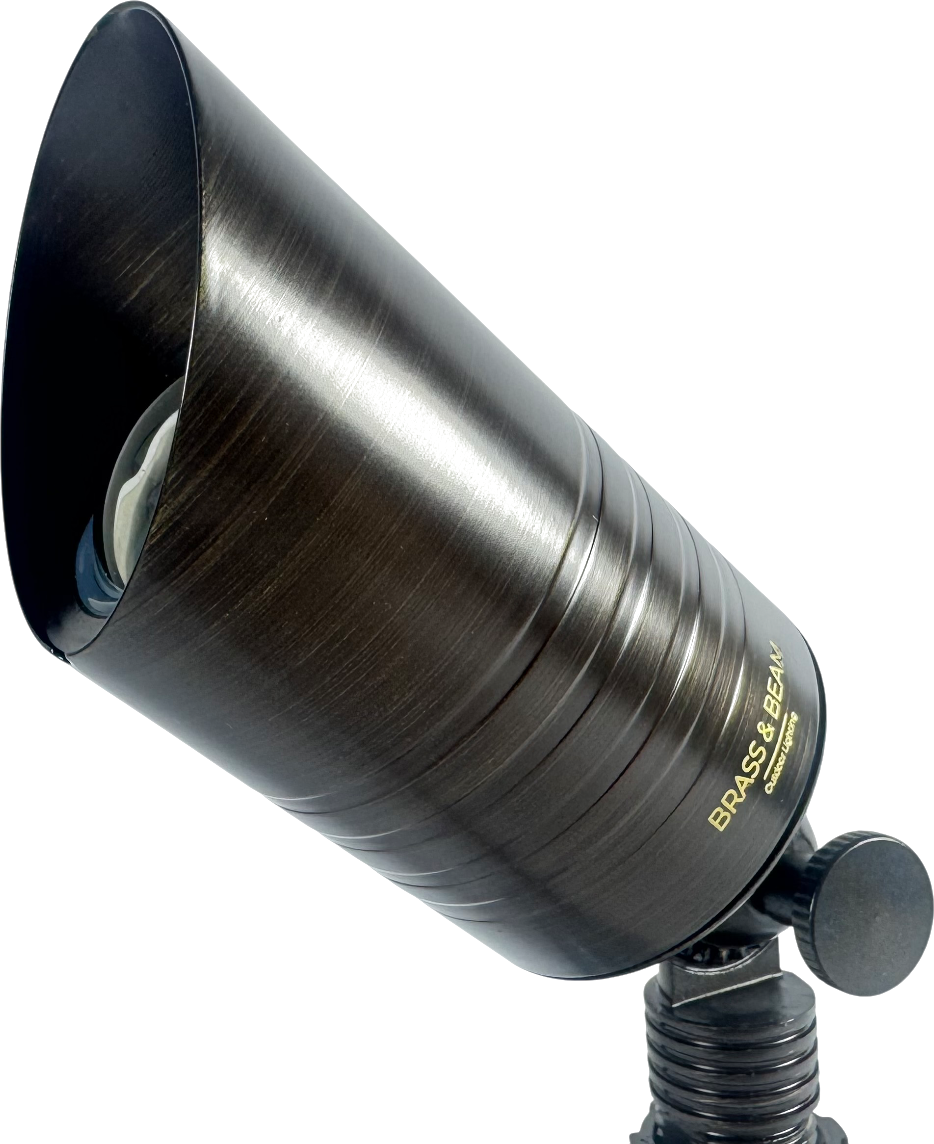
This is the workhorse of almost every uplighting plan — a small, adjustable brass fixture, ground-mounted or staked, with a knuckle joint that lets us aim the beam precisely at whatever we're highlighting. Point it up the trunk of a mature oak and the whole canopy comes alive. Angle it toward a column or a stretch of stone facade and you get a tight, controlled wash that reveals texture without blowing out the surface. The adjustability is the whole point: a fixture aimed once during installation and never touched again, holding its angle through wind, mowing, and seasons of freeze-thaw. It's the fixture doing the most work while asking for the least attention.
02
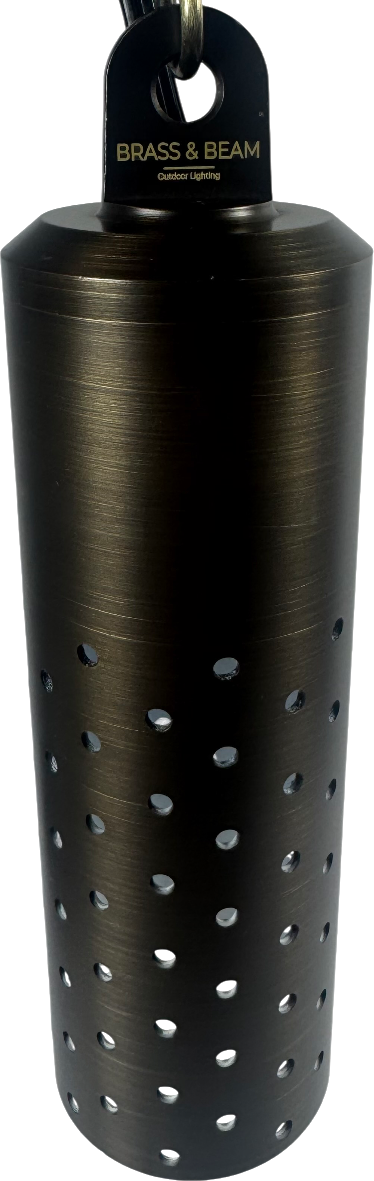
This one's mounted high, up in the branches of a mature tree, pointed straight down through the canopy. Its perforated body scatters the light as it passes through, so what lands on the lawn below isn't a single hard beam — it's a soft, dappled pattern of light and shadow that shifts slightly as the leaves move, almost exactly like real moonlight filtering through branches. It's the fixture people notice last and remember longest, because it doesn't look installed at all. Best suited to properties with large, established trees positioned over a patio, lawn, or entry path where that natural, shifting light does the most good.
03
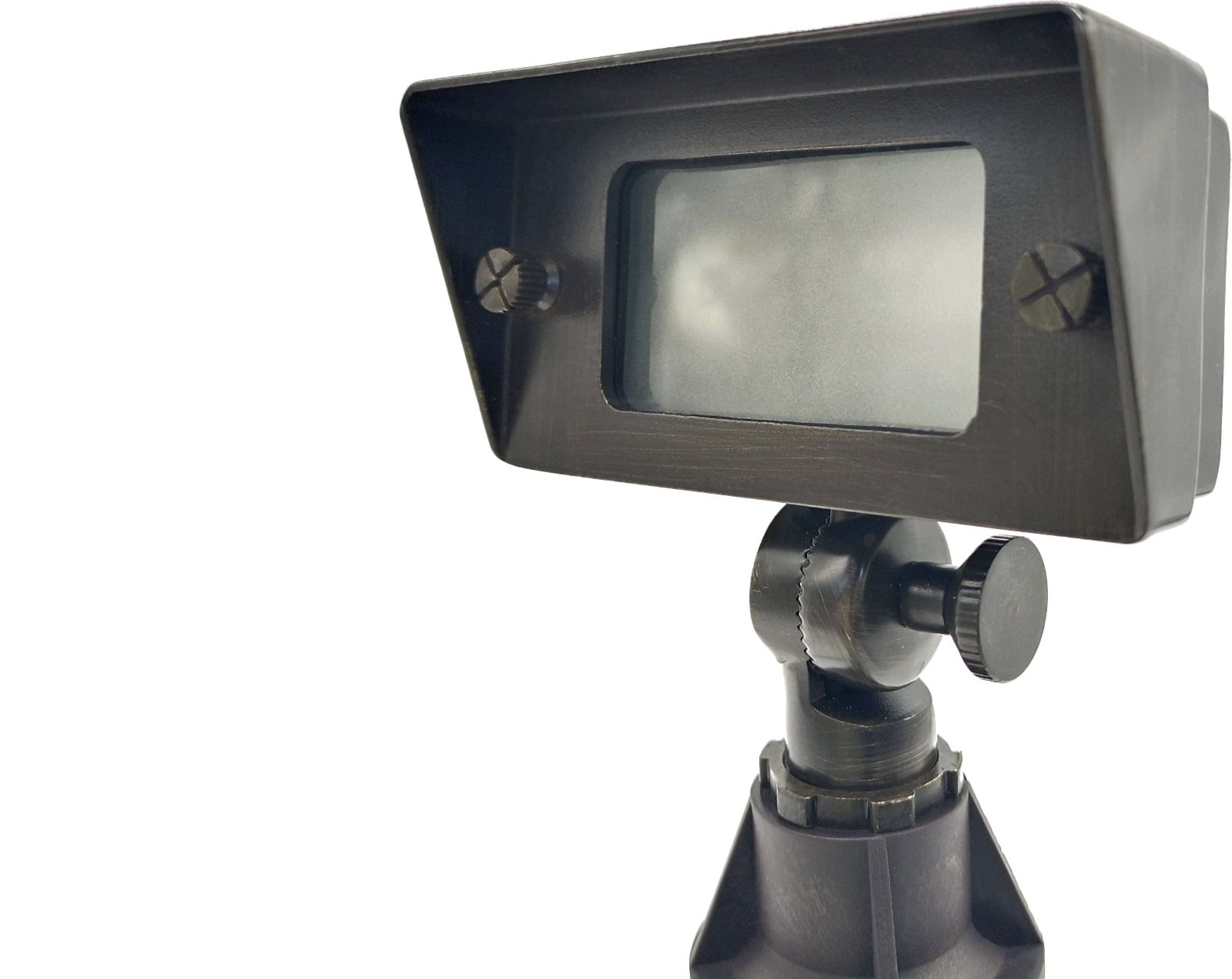
Where a bullet spotlight throws a narrow, focused beam, this fixture is built for width. Its wider lens spreads light evenly across large flat surfaces — broad stretches of siding, a garage door, a retaining wall, the full gable end of a house. It's the fixture we reach for when a feature is simply too wide for a single point of light to do it justice, and we need even, edge-to-edge coverage instead of a hot spot in the middle. Used well, it's subtle — you notice the wall looks finished, not that a light is aimed at it.
04
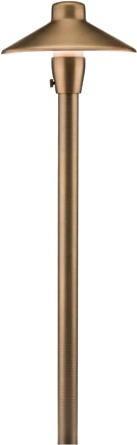
The classic pagoda-style fixture set on a stake along a walkway or garden bed. Its wide cap shields the bulb from direct view, so what you see walking up isn't a row of glowing bulbs staring back at you — it's a pool of soft light spilling downward onto the path itself. Spaced correctly, a run of path lights does two jobs at once: it's genuinely useful for safely finding your footing after dark, and it quietly defines the shape of a walkway or bed line in a way that reads as intentional, not just functional.
That's exactly what a free design consultation is for.
Get Your Free Consultation